A Founder’s Guide to Define Customer Retention in SaaS
Customer retention isn’t a defensive tactic to stop churn. It’s an offensive strategy: proactively and consistently delivering on your product’s core promise.
In B2B SaaS, retention means customers achieve their desired outcomes using your tool. When they succeed, they stay — and your company compounds.
The simplest definition
Retention is the percentage of customers who keep paying because they keep getting value. If your metrics don’t connect to value, you’re measuring noise.
Defining Customer Retention Beyond a Single Percentage
A precise definition of customer retention is non-negotiable. It’s more than the percentage of customers you keep each month — it’s proof that your product delivers tangible value. That proof drives your growth, profitability, and (eventually) valuation.
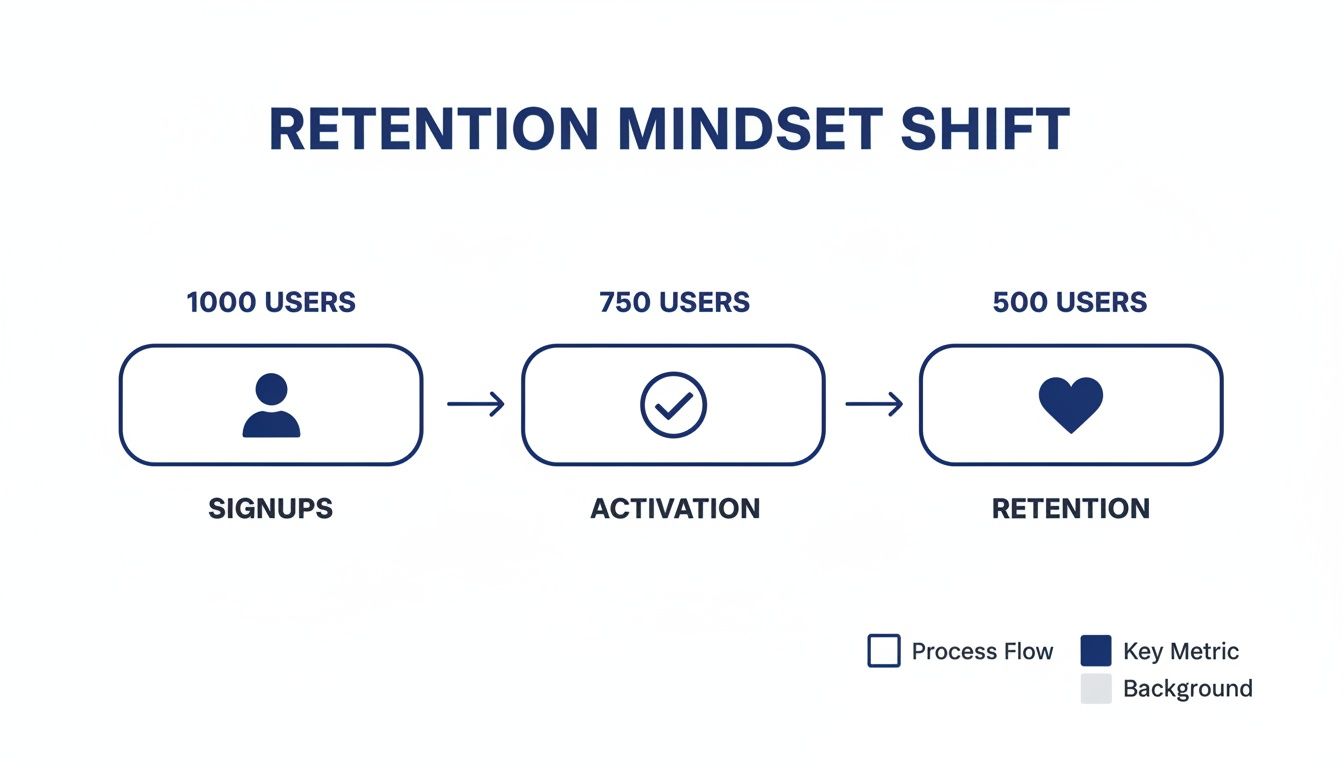
This matters even more in product-led growth (PLG). Sign-ups are a vanity metric. Retention starts much earlier than month 2 or month 3: it starts at the “aha!” moment, when a user experiences value for themselves.
From Acquisition Metrics to Activation Metrics
A PLG project management tool can have great trial sign-up charts and still struggle with revenue if trial-to-paid conversion is low. The fix is to define retention as a value journey — not a cancellation rate.
Instead of celebrating raw sign-ups, shift focus to early milestones that predict staying power:
- Activation Rate: What percent create a first project within 24 hours?
- Collaboration intent: How many invite at least one teammate in week 1?
- Core feature adoption: Do they use the primary planning workflow?
This reframing turns retention into a leading indicator (success), not only a lagging indicator (churn).
If you want the tracking mindset behind this, see Unlocking Product Analytics for SaaS Growth.
The Core Formulas for Measuring SaaS Retention
To define customer retention, you need to measure it. For B2B SaaS, two metrics usually matter most:
- Logo Retention: are customers staying?
- Net Revenue Retention (NRR): is revenue from existing customers expanding or shrinking?
Key Retention Metrics for B2B SaaS
| Metric | What It Measures | Why It Matters |
|---|---|---|
| Logo Retention | The percentage of customers (logos) you keep over a period. | Measures product stickiness: are you solving a real pain consistently? |
| Net Revenue Retention (NRR) | Revenue retained from existing customers, including expansions, downgrades, and churn. | Reveals financial momentum. Over 100% means you can grow even without new logos. |
Why both matter
You can retain customers but lose revenue via downgrades (good logo retention, bad NRR), or you can grow revenue while churning small customers (bad logo retention, strong NRR). You need the full picture.
Implementation Section: Making Metrics Actionable
Formulas tell you what happened. Cohorts tell you why.
Group customers by signup week/month (or by first-paid date), then track retention over time. When one cohort underperforms, ask:
- Did we ship a breaking change?
- Did onboarding or lifecycle messaging change?
- Did we attract a different segment (worse fit)?
To track the right “usage signals” inside those cohorts, start with the engagement metrics definition—then turn it into an engagement tracking plan.
Why Retention Is Your Most Powerful Growth Engine
Strong retention is the most effective offensive strategy for sustainable SaaS growth.
When customers stay:
- LTV increases (more months of value delivery).
- CAC payback improves (same acquisition cost amortized longer).
- Referrals rise (advocacy is easier when outcomes are clear).
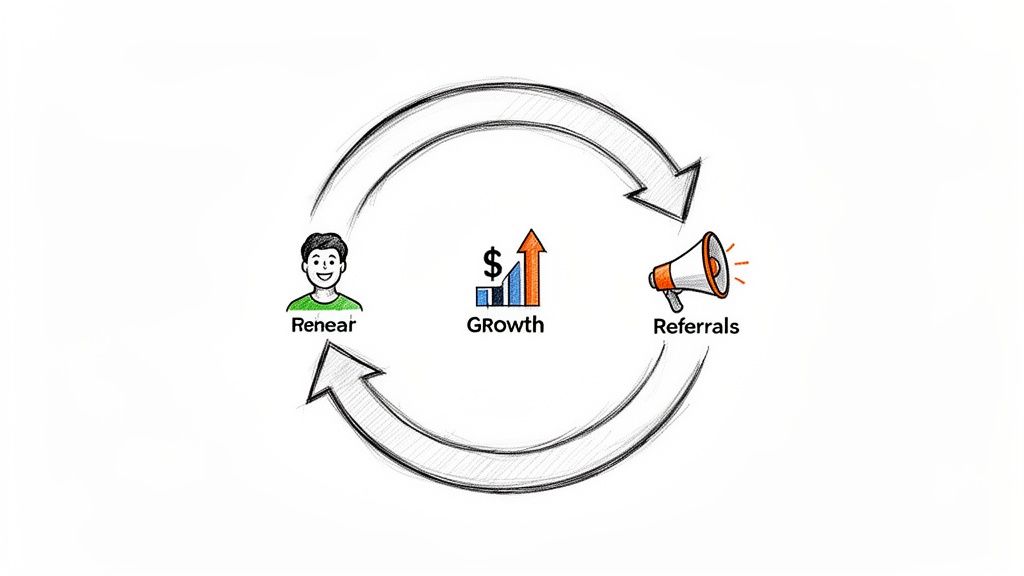
Turning Customers Into a Flywheel
Your best customers don’t just pay. They compound your growth:
- Expand: more seats, higher tiers, deeper usage (drives NRR)
- Advocate: reviews, case studies, internal champions
- Refer: better-fit leads at lower acquisition cost
Moving from a Churn Mindset to a Retention Mindset
Churn and retention are related, but they drive different behaviors.
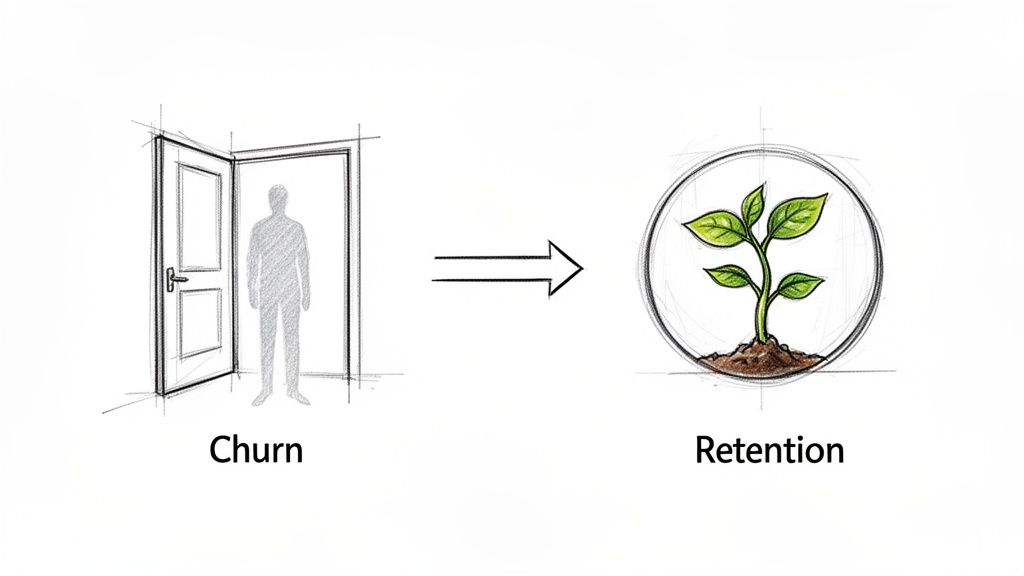
- Churn is reactive: it counts who left.
- Retention is proactive: it measures the value that convinces users to stay.
Implementation Example
A project management tool wants to reduce 5% monthly churn.
- Churn mindset: optimize a slow reporting feature because cancellation surveys complain about it. Churn drops briefly, then returns.
- Retention mindset: analyze loyal users and find a pattern: accounts that invite teammates and create a shared dashboard in week 1 rarely churn.
That insight changes the plan: redesign onboarding to guide all new accounts toward those actions.
How to Automate Your Trial-to-Paid Strategy (Without Spamming Users)
For PLG companies, the free trial is where retention is won or lost. To win at scale, automation can’t be “more emails.” It must be behavior-driven guidance.
Implementation Playbook: Automating Onboarding
- Identify key activation events: the actions that correlate with long-term retention.
- Track progress against milestones: who’s moving forward vs stalled.
- Trigger contextual nudges: in-app messages and emails based on action/inaction.
For concrete onboarding tactics, see Customer Onboarding Best Practices.
The EngageKit View: Retention Is Built in the Trial
Most teams can measure churn. Fewer teams can consistently prevent it — because the work has to happen before churn becomes inevitable.
EngageKit helps you operationalize retention by turning product signals into action:
- Define retention-driving milestones: activation, adoption, team signals.
- Detect stalls early: find users who aren’t progressing toward value.
- Guide users automatically: nudge the next best step in-app and via follow-up.
If you’re tired of leaky buckets, start by defining the exact behaviors that predict retention — then build a system to guide users to those behaviors every time.
Subscribe to our newsletter
The latest news, articles, and resources, sent to your inbox weekly.